Cameron Rowland
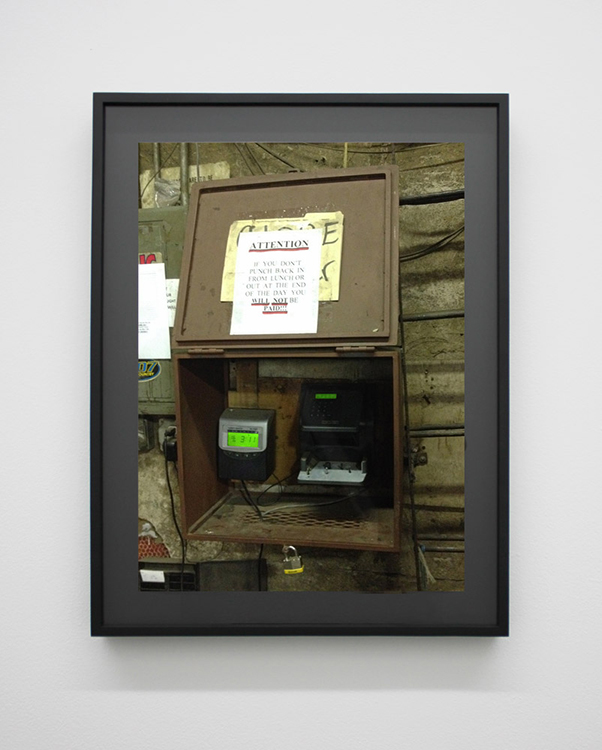
Handpunch, 2014: Photograph
“In businesses where employees’ time is one of the most valuable assets, the Handpunch time clock secures this time. The Handpunch uses biometric readings of employees’ right hands to inhibit false clock-ins and payment for false hours. Biometric recognition was developed to replace photography as a superior form of criminal indexing.”
“In a 2016 exhibition, 91020000, Rowland presented a series of objects—including courtroom benches, desks, and leveler rings for manhole openings used in road construction—manufactured by New York State prison inmates, who are paid $0.10 to $1.14 an hour.”
MacArthur Foundation
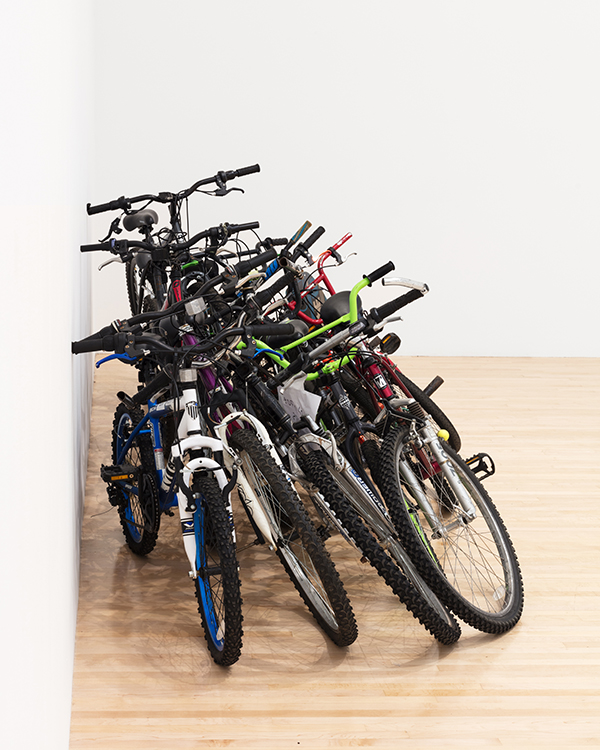
Group of 11 Used Bikes –Item: 0281-007089, 2018: Group of 11 Used Bikes sold for $287.00
In the United States, property seized by the police is sold at police auction. Auction proceeds are used to fund the police.
Police, ICE, and CBP may retain from 80% to 100% of the revenue generated from the auction of seized property.
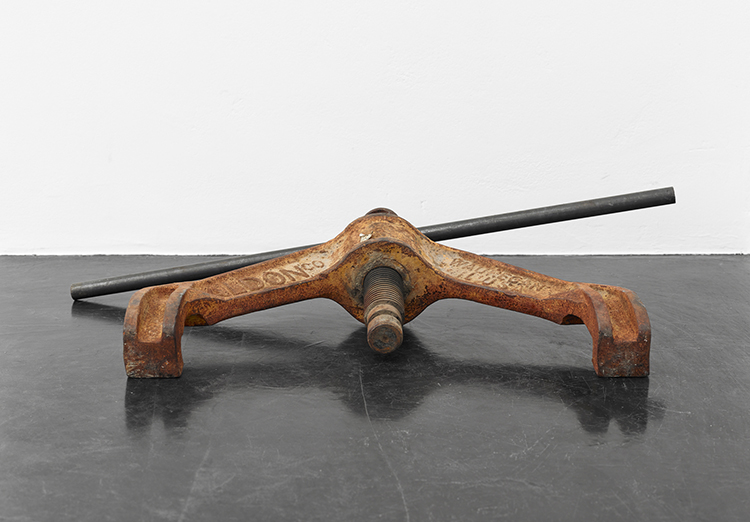
Jim Crow, 2017: Jim Crow rain bender
“Jim Crow is a racial slur, but a Jim Crow is also a type of manual railroad rail bender. It has been referred to by this name in publications from 1870 to the present. The lease of ex-slave prisoners to private industry immediately following the Civil War is known as the convict lease system. Many of the first convict lease contracts were signed by railroad companies.”
“Plessy v. Ferguson contested an 1890 Louisiana law segregating black railroad passengers. The Supreme Court upheld the law as constitutional. This created a precedent for laws mandating racial segregation, later to be known as Jim Crow laws.”
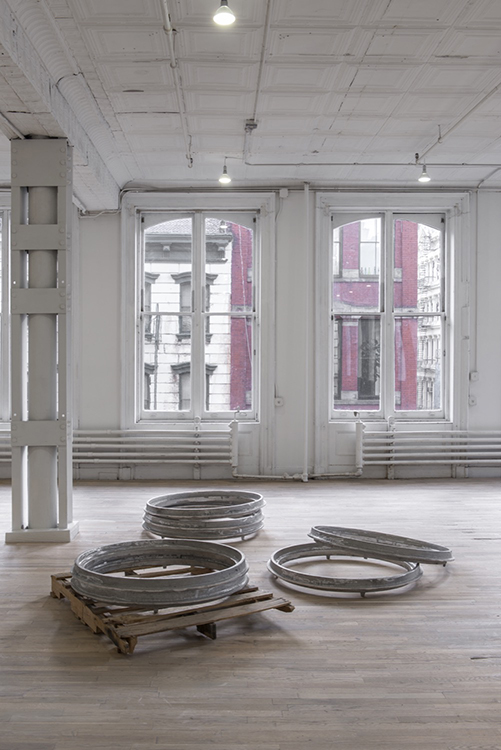
Leveler (Extension) Rings for Manhole Openings, 2016: Cast aluminum, pallet, distributed by Corcraft
“Manhole leveler rings are cast by prisoners in Elmira Correctional Facility. When roads are repaved, they are used to adjust the height of manhole openings and maintain the smooth surface of the road. Work on public roads, which was central to the transition from convict leasing to the chain gang, continues within many prison labor programs. The road is a public asset, instrumental to commercial development.”
They were manufactured by New York State prison inmates, who are paid $0.10 to $1.14 an hour.
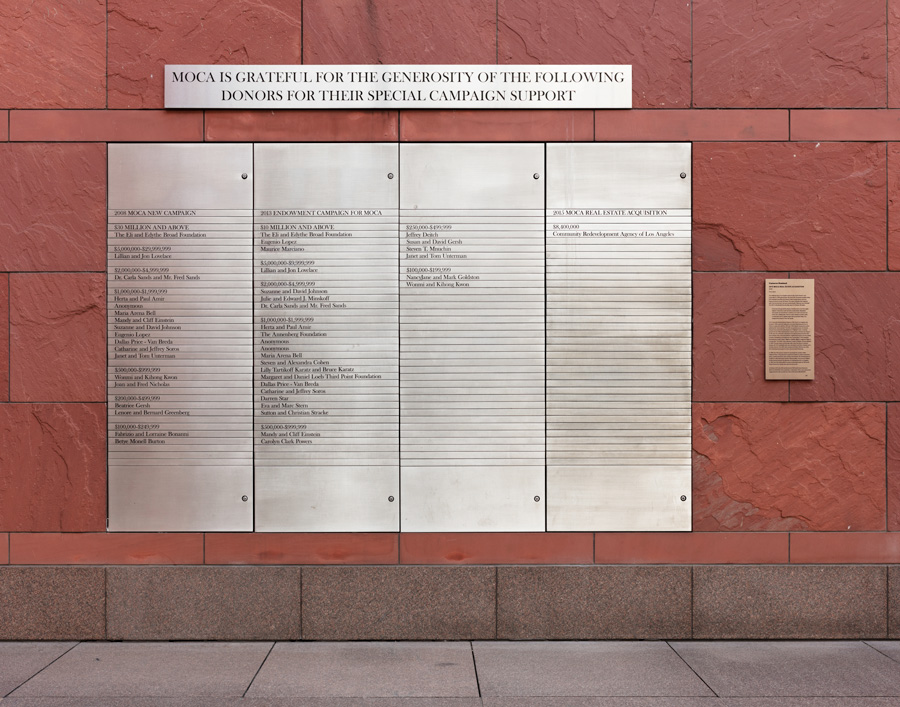
MOCA REAL ESTATE ACQUISITION, 2015: DONOR PLAQUE
The Community Redevelopment Agency of the City of Los Angeles was formed in 1948 under the California Community Redevelopment Act of 1945, in conjunction with the 1937 and 1949 federal Housing Acts, which authorized its “slum removal.” The CRA was granted powers of eminent domain to be used in the redevelopment of “blighted” areas.
The museum outlined in this proposal became The Museum of Contemporary Art, Los Angeles. In 1983, the CRA offered MOCA a lease on the land located at 250 South Grand Avenue for a ninety-nine- year term at no rent.
In October 2015, the CRA sold the land at 250 South Grand Avenue to MOCA for $100,000. One month later, in November 2015, a tax assessment triggered by the sale recorded the value of the land at $8,500,000.
MacArthur Foundation
Subject Vs. Content: Moca Real Estate Acquisition
Through his art and his research, Cameron Rowland educates his audience about America’s perpetual issue of systemic and institutional racism and inequality. Much of his art consists of the display of objects that represent Americans that are marginalized and treated unjustly (economically and racially). In 2015 Moca Real Estate Acquisition, Rowland describes the effects of redlining, “slum removal”, and community redevelopment in Los Angeles. In this piece, a ‘donor plaque’ is placed on land that was sold for redevelopment, listing the names of the share-holders and those that had a part in the ‘redevelopment’ of the land. Over 7,000 residents were considered “low-income” and were mostly of Mexican or Asian descent.
Creating this plaque demonstrates some of the worst inequities our country allows. Thousands, if not hundreds of thousands of individuals were marginalized and displaced in the era of “urban renewal” and many continue to be today. Those with power and those that benefit from this displacement of those without power try and often succeed in masking these unjust doings as ‘redevelopment’ or landmark renewals. Rowland uses this format to show to us just how twisted and manipulative this process is and shows to his audience the efforts those in power take to conceal this economic and social inequality.
Relevance
Public art projects often support the ideas of sustainability, and Rowland’s art is no different. Rowland uses his art to demonstrate to the audience the economic and social injustices marginalized Americans face day to day and have faced historically.
“…Removed from banal daily encounters, these objects – such as Pass-Thru (2014), for which Cameron constructed a bullet-proof box modelled on those used to protect transactions of money and goods at a bank or shop – become totemic markers of complex webs of control, exploitation and capital. These almost indexical or evidentiary assemblages sidestep sentiment while challenging the viewer to reassess the stuff that surrounds us as material evidence attesting to the function of power.”
– Natasha Hoare, from the January and February Issue of ArtReview
 David's Blog