Brandon Ballengee
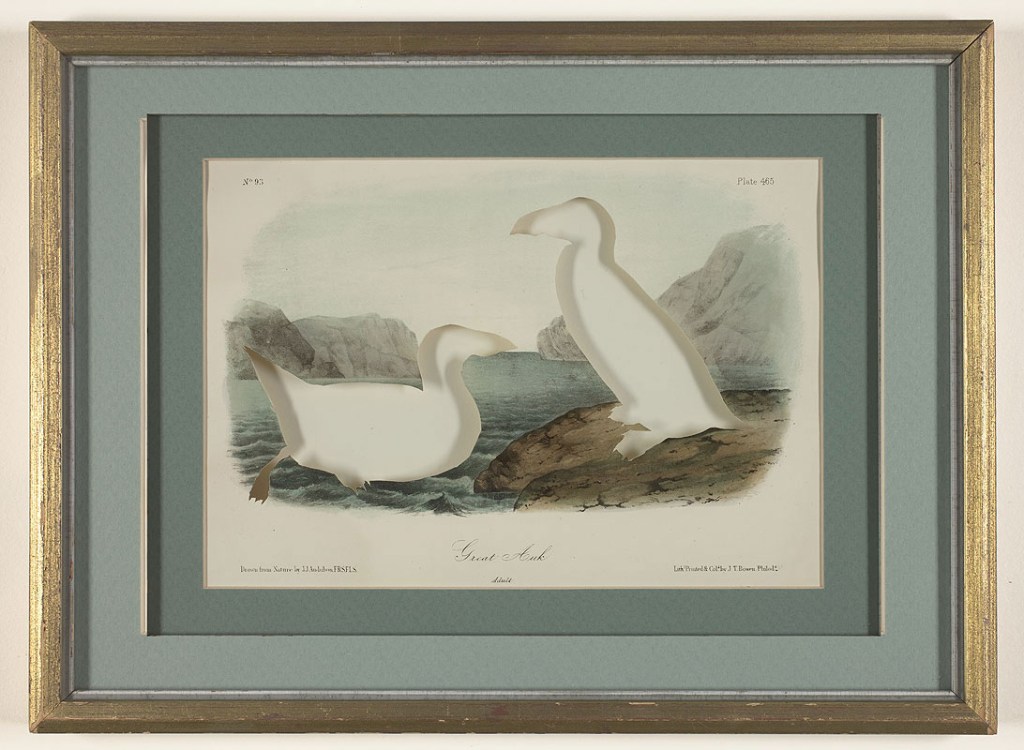
RIP Great Auk. 1971/2009 (Frameworks of Absence – 2006-Ongoing): Lithograph from the Bowen Editions Royal Octavo of ‘The Birds of America.’
“We are in the middle of a biodiversity crisis, often referred to as the Holocene or the Sixth great extinction.” (Ballengee). Responding to today’s events, the artist cut images of extinct animals from prints, publications, and paintings that were created at the time the species went extinct. The Great Auk was last observed in the 1840’s and this image was printed in 1856 as part of the Royal Octavo.
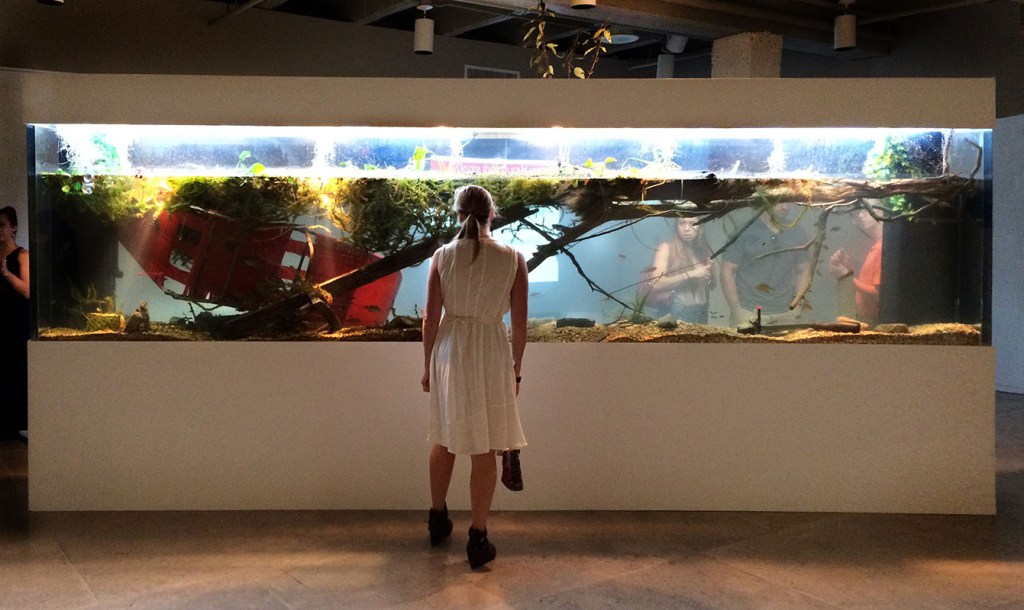
Mississippi Delta Eco-Displacement. Installed 2014 (Eco-Displacements): Aquatic Organisms, detritus.
In Eco-displacements, “participants collect specimens, artifacts and polluted water, part sculptural installations, that show a living cross-section of a wetland and often the degradation found within.” (Ballengee).
Viewers are able to physically engage with the art and see ecosystems they usually do not, particularly wetland ecosystems. The artist stresses the importance of understanding our connection with these ecosystems and these organisms.
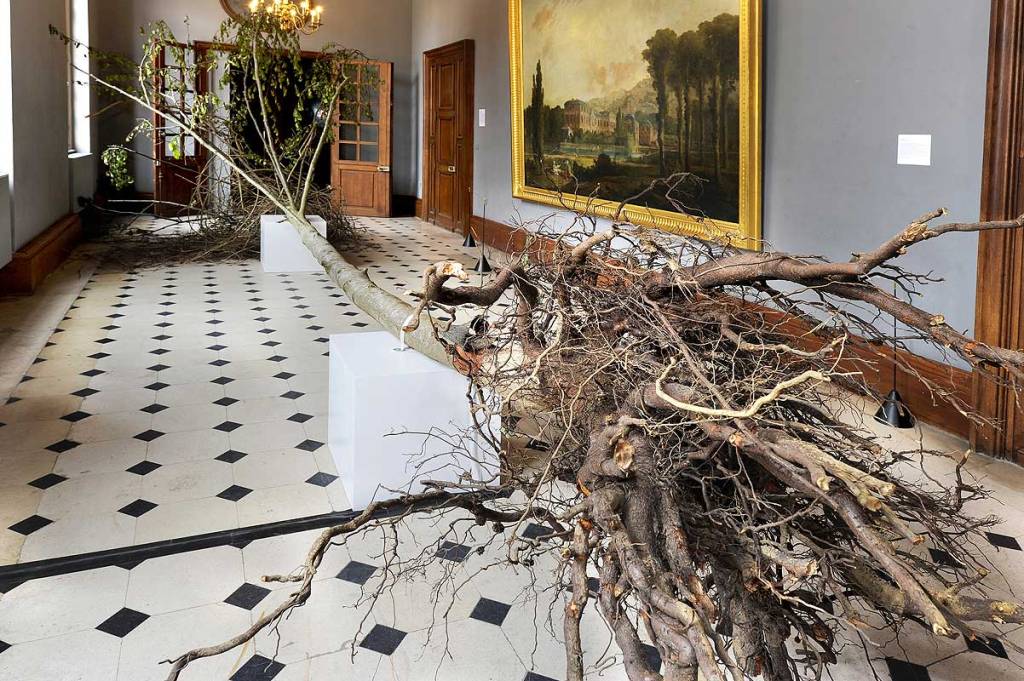
Dying Tree. 2013: Domaine de Chamarande, France: Tree.
With this piece, Ballangee focuses on the fact that humans view the world through a largely anthropocentric lens. We usually don’t see trees as truly living, and when non-sentient beings die, we hardly notice or care.
Having such short lives, we also have a limited perception of time, so the fact that some species may live for thousands of years is alien to us.
The artist embedded ‘highly sensitive microphones’ into the outer layers of the tree to amplify the sound of the death of the trees tissue.
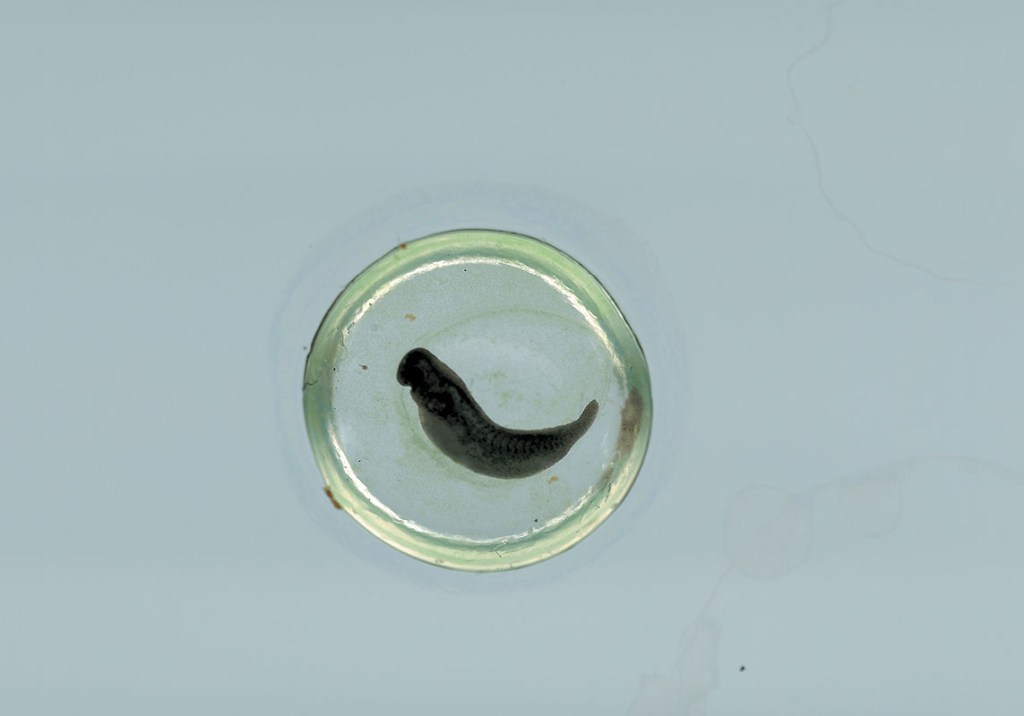
Spotted Salamander Egg. 2000/01 (Early Life): Iris prints on Arches watercolor; Ambystoma maculatum at 94hrs.
This is the first of 11 images of the first 8 days of life of two amphibian species.
“In 1989 at an international herpetological conference, scientists discovered that all over the globe amphibian populations [were] disappearing!” (Ballangee). This disappearance was happening everywhere and was/is the result of global climate change and atmospheric deterioration.
They were manufactured by New York State prison inmates, who are paid $0.10 to $1.14 an hour.

DP 34: Common Yellow Tumbler. 2003/09 (A Habit of Deciding Influence: Skins): Common Yellow Tumbler, pigmented ink prints on watercolor paper.
From 2003 to 2012, Ballangee photographed skins and skulls from a collection of pigeon specimens.
“The ‘skins’ were digitally collaged on backgrounds created from microscopic sccans of laboratory cotton. […] The intention was to recall atmospheres in 19th century paintings. […] The ‘skulls’ were visually isolated in dramatic settings to recall artworks in the tradition of the Memento mori.” (Ballangee).
Subject Vs. Content: Dying Tree
Being a visual artist, biologist, and environmentalist, Brandon Ballangee automatically has a unique and interesting way of making art. Much, if not all, of his artworks are inspired from his work in ecology and research in his lab. In Dying Tree, Ballangee displays a large dying tree in a hall of the Domaine de Chamarande. He displaced an ‘ill’ tree and attached small, sensitive microphones inside and out of the tree. The audience can hear the sounds of water evaporating and leaving the body and tissue of the tree.
Dying Tree effectively illustrates some of the most important concepts in environmentalism and environmental philosophy: anthropocentrism, the concept of time, and the concept of life and death. As stated in the description, “Most of us cannot even contemplate our own short existence let alone those of organisms such as trees, which in some species may live for over 2000 years.” (Ballangee). It is hard for us to imagine the life and death of other beings and this piece makes it just a little bit easier to do so.
Dying Tree is also a reference to DEAD TREE (1969), by Robert Smithson.
Relevance
I have always been interested in environmentalism, activism and the study of ecosystems. It is interesting to see the exploration and connection of this concept in public art. Environmental sustainability is a major topic today, and much of this artist’s works focus on this topic.
“…Brandon Ballengée, artist/ biologist/environmental activist, will transform the Feldman Gallery booth into a space to mourn the massive extinction of species, often referred to as the Holocene or Sixth Great Extinction, which continues at an alarming rate. Pioneering in ecological art, Ballengée has been described by the critic and curator Kim Levin “as taking these issues to a new level of intensity.” He conceptualizes material of great consequence, and the installation is both a cri du coeur and a call to action that balances the evocative with the proactive…”
– Ronald Feldman Fine Arts, 2015
 David's Blog